
UTI PREVENTION FOR CHRONIC SUFFERERS
The routine that keeps you off antibiotics.
A daily supplement at actual therapeutic doses, built for the sex-then-UTI-then-antibiotics loop.
Shop prevention"Supports urinary tract health" is not a dose. Most UTI gummies carry a tenth of what the research used — and charge you for the vibes.
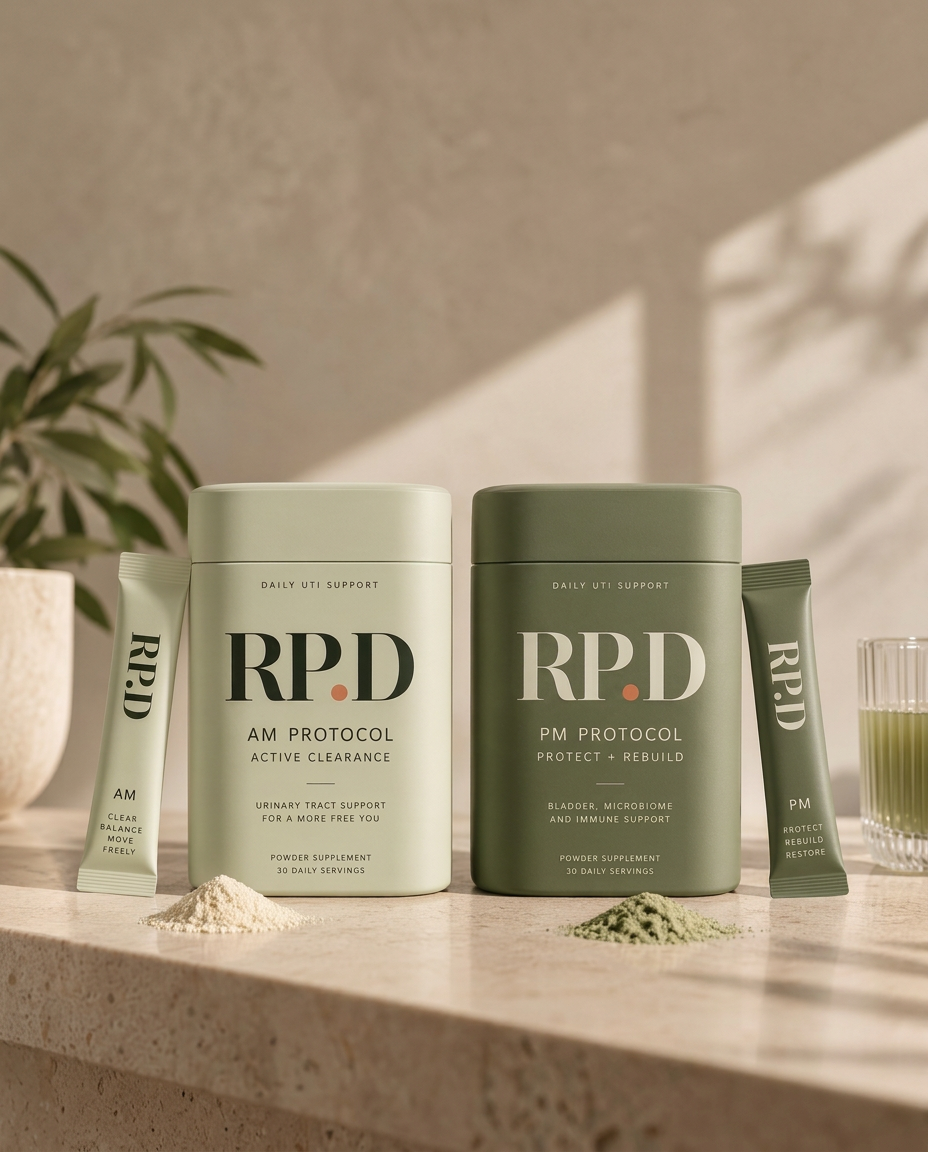
Two sachets a day · 30-day supply
RP.D AM / PM protocol
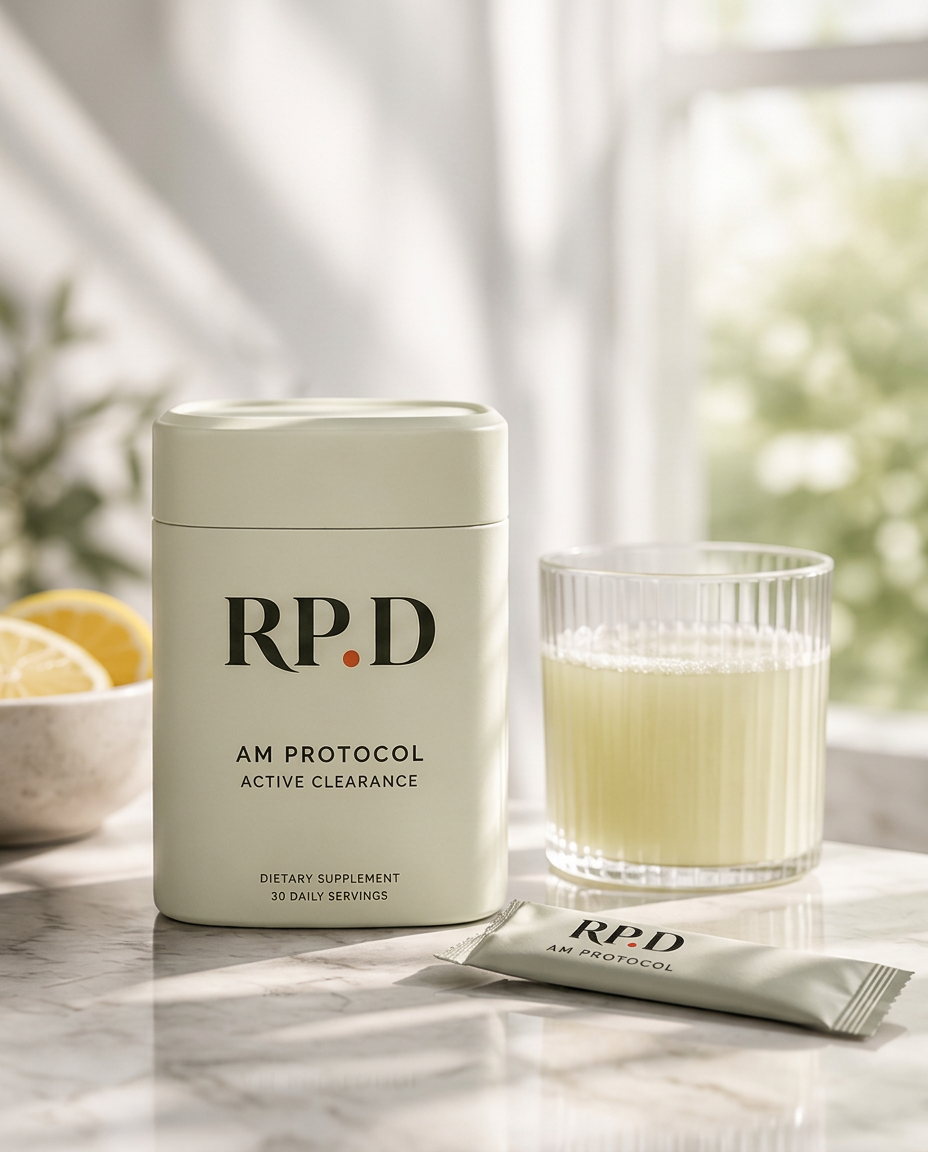
One sachet fasted in the morning to clear. One at night with food to protect and rebuild. Twelve actives, every dose printed, nothing hidden in a blend.
- AM: D-mannose 2,000 mg, monolaurin 2,400 mg, serrapeptase 40,000 IU, NAC 600 mg
- PM: 36 mg measured A-type PACs, L. crispatus + GR-1 + RC-14, lactoferrin 250 mg
- Covers Staph saprophyticus and Klebsiella — not just E. coli
Subscribe & save 15%
Pause or cancel anytime
The science · Part one
Clinically informed. Actually preventive.
01 — Adhesion
Bacteria grip your bladder wall
Uropathogenic E. coli extend hair-like fimbriae tipped with adhesins that latch onto the sugars coating your urothelial cells. Grip is step one of every infection.
02 — Ascension
They climb the urethra
The female urethra is about 4 cm long — a short trip. Sex physically pushes perineal bacteria toward the opening. That's not a hygiene failure; it's anatomy and mechanics.
03 — Biofilm
They hide and wait
Some bacteria invade bladder cells or build biofilm communities. Antibiotics clear the free-swimming ones. The hidden reservoirs survive — and relaunch the infection.
The science · Part two
Know your enemy. All four of them.
Ranked by frequency in UTI. Each one adheres to your bladder differently — which is exactly why a single-ingredient product can't cover them all.
01 · ~80% of UTIs
Escherichia coli
+++ The dominant cause by a wide margin. Normally harmless in the gut; the short female urethra gives it easy access. It carries both type-1 fimbriae (blocked by D-mannose) and P-fimbriae (blocked by A-type PACs) — which is why those two ingredients have the most evidence behind them.
02 · ~5–15% of UTIs
Staphylococcus saprophyticus
+++ Gram-positive, grows in grape-like clusters. Almost exclusively affects women 16–35, and rarely shows up in chronic UTI. Critically: D-mannose and cranberry PACs do not work against it.
03 · ~5–10% of UTIs
Klebsiella pneumoniae
+++ Encapsulated — an extra-thick protective outer layer — and very good at forming biofilm. D-mannose and PACs don't touch it. Massively over-represented in the chronic UTI community because it's so hard to clear.
04 · ~2–5% of UTIs
Proteus mirabilis
+++ Whip-like flagella let it swarm in coordinated waves. Its urease enzyme turns urine alkaline, which can lead to struvite kidney stones that harbour still more bacteria. More common with catheters and in older patients.
The core problem
Almost every UTI supplement is built entirely around E. coli.
D-mannose targets E. coli type-1 fimbriae. A-type PACs target E. coli P-fimbriae. Both are excellent — at one organism.
Neither has any meaningful effect on Staphylococcus saprophyticus, because it adheres through completely different mechanisms: primarily a protein called UafA that binds fibronectin on the bladder wall, plus a hemagglutinin that latches onto urothelial cells. Different hooks entirely. Klebsiella, with its capsule and biofilm, shrugs both off too.
The standard supplement stack does nothing for them. That's the gap this formula was built around.
The science · Part three
Why "just one more round" never ends.
The reservoir survives
Standard antibiotics clear free-floating bacteria in days. Intracellular communities and biofilm pockets — the reservoirs — remain untouched.
Your flora pays the price
Broad-spectrum antibiotics also wipe out the protective lactobacilli that acidify the vaginal environment. Recurrence risk spikes in the weeks right after a course.
Resistance compounds
Every course trains surviving bacteria. E. coli resistance to first-line drugs like trimethoprim now exceeds 20–30% in many regions.
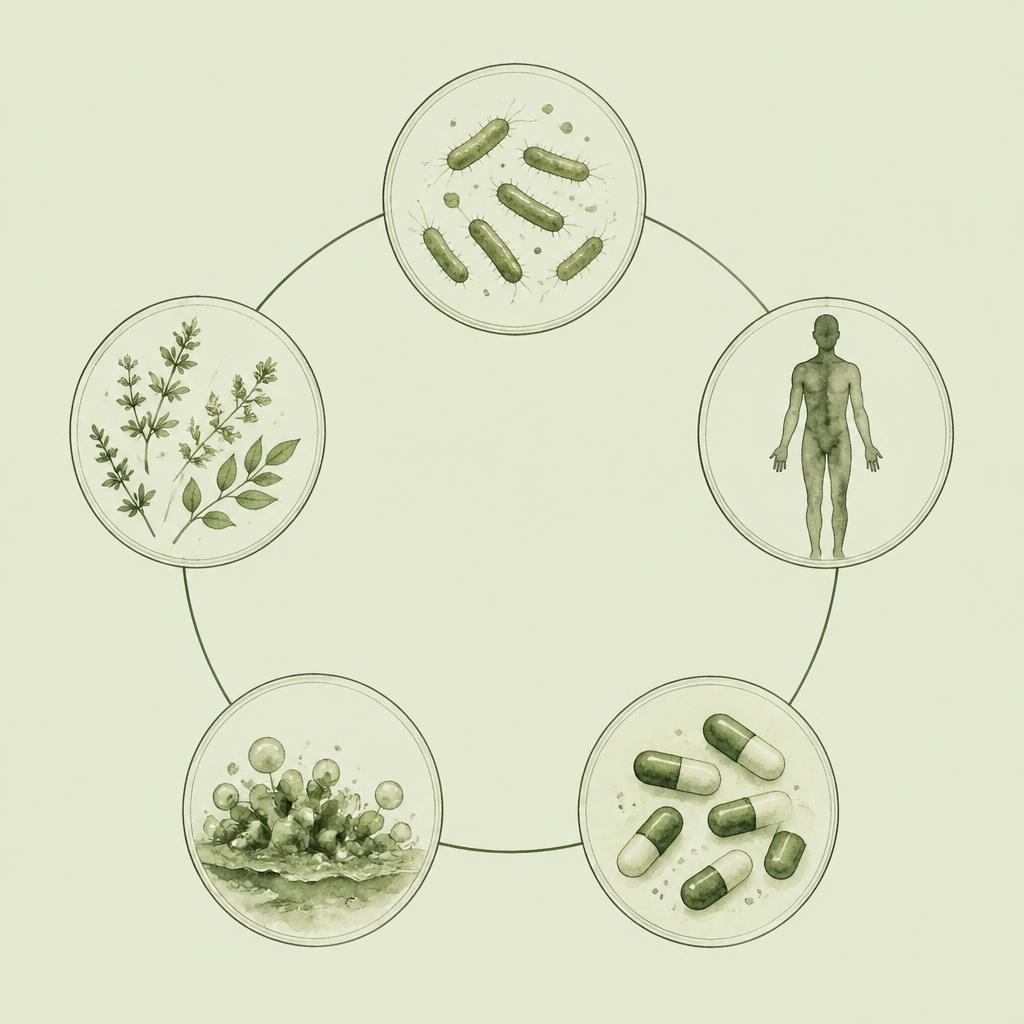
The recurrent loop — and where prevention breaks it
Full transparency
Two sachets. Twelve actives. On the record.
Sachet 01 — AM, fasted
Active clearance
The offensive work: breaking down biofilm, antimicrobial activity, flushing bacteria out. Mixed with water first thing, before food — serrapeptase is destroyed by gastric acid otherwise.
D-Mannose
2,000 mg
Blocks E. coli type-1 fimbriae. Needs a high urinary concentration — the morning dose maximises dwell time.
Monolaurin
2,400 mg
Antimicrobial activity against gram-positive bacteria — including Staph saprophyticus, which D-mannose and PACs do nothing for. Absorbed systemically.
Serrapeptase
40,000 IU
Enzymatic biofilm breakdown. Must be taken fasted or stomach acid degrades it before absorption.
NAC
600 mg
Biofilm disruption; absorption is best on an empty stomach.
Oregano oil extract
100 mg
Standardised to 80% carvacrol, microencapsulated to mask the flavour. Broad antimicrobial coverage.
Vitamin C
500 mg
Urine acidification and immune support.
Sachet 02 — PM, with or after food
Protect and rebuild
The defensive work: rebuilding the vaginal microbiome, blocking adhesion, supporting the bladder wall. Food buffers stomach acid so more probiotic survives — and overnight gives them maximum dwell time.
A-type cranberry PACs
36 mg
From a certified juice extract (~200–240 mg extract). Anti-adhesion against E. coli P-fimbriae — the validated dose, measured and printed.
L. crispatus
5B CFU
Microencapsulated beadlets. The single most important urogenital probiotic strain.
L. rhamnosus GR-1
3B CFU
Vaginal microbiome restoration.
L. reuteri RC-14
3B CFU
Companion strain to GR-1 — together the most clinically studied combination.
Lactoferrin
250 mg
Iron-binding glycoprotein — starves uropathogens of the iron they need and supports mucosal defence.
Vitamin D3
1,000 IU
Bladder wall support.
The dose gap
Same shelf. Very different labels.
| What's inside |  | Typical "UTI gummy" |
|---|---|---|
| E. coli anti-adhesion | D-mannose 2,000 mg + 36 mg PACs | 500–1,000 mg, PACs undisclosed |
| Gram-positive coverage (Staph sap.) | Monolaurin 2,400 mg + oregano | None — E. coli only |
| Biofilm breakdown (Klebsiella) | Serrapeptase 40,000 IU + NAC 600 mg | None |
| Iron sequestration | Lactoferrin 250 mg | None |
| Urogenital flora rebuild | L. crispatus, GR-1, RC-14 | Generic gut strains, if any |
| Timing designed around absorption | AM fasted / PM with food | One gummy, whenever |
| Dose transparency | Every mg on the label | 'Proprietary blend' |
"Typical" figures reflect a survey of best-selling urinary-health supplements on major US retailers, 2026. Check your current label — we'll wait.
Side by side
Against the brands you already know.
The three most-bought urinary-health products in the category, next to the full RP.D AM/PM protocol. Doses per day, as printed on each brand's own label.
| Per day | 2 sachets · AM + PM | UqoraFlush + Defend + Promote regimen | Ellura1 capsule | Utiva1 capsule |
|---|---|---|---|---|
| D-mannose | 2,000 mg | 2,000 mg | — | — |
| A-type cranberry PACs | 36 mg (measured) | — | 36 mg | 36 mg |
| Gram-positive coverage (Staph sap.) | Monolaurin 2,400 mg + oregano 100 mg | — | — | — |
| Biofilm disruption | Serrapeptase 40,000 IU + NAC 600 mg | Herbal blend (Defend) | — | — |
| Lactoferrin (iron sequestration) | 250 mg | — | — | — |
| Urogenital probiotics | L. crispatus + GR-1 + RC-14 · 11B CFU | L. acidophilus + L. rhamnosus (Promote) | — | — |
| Vitamin D3 | 1,000 IU | Yes (Defend) | — | — |
| Vitamin C | 500 mg | 480 mg | — | — |
| AM / PM absorption timing | Fasted AM + with-food PM | — | — | — |
| Price per month | $55 · two sachets a day | ≈ $52 (3 products) | ≈ $43 | ≈ $45 |
Competitor formulas and prices as published on uqora.com, ellura (via Amazon), and utivahealth.com, checked September 2026. Uqora's closest equivalent to RP.D is its three-product regimen (≈$52/mo on subscription): Flush supplies the D-mannose, Defend is an herbal biofilm-support blend, and Promote is a two-strain probiotic — none contain PACs, monolaurin, serrapeptase, NAC, or lactoferrin. Ellura and Utiva are single-ingredient cranberry PAC capsules: the clinically validated 36 mg, but E. coli anti-adhesion only. Prices change; verify on the brand sites. Trademarks belong to their respective owners — no affiliation or endorsement implied.
QUIET MONTHS
"Three infections in five months. Then six quiet months of nothing. I forgot what my pharmacy's parking lot looks like."
— Shannon Graybill, 39 YO
RP.D daily defense
$55 · 30-day supply
What we stand by
Not a cure
Burning right now? That's an active infection. See a clinician, get the culture, take the antibiotic. RP.D exists so that happens less often.
Prevention over crisis
The goal is boring: months where nothing happens. Quiet bladders don't make dramatic ads, but they make better lives.
Science on the label
Every dose in RP.D matches the quantities used in published research. If the evidence for an ingredient is thin, it doesn't go in the sachet.
Questions, answered honestly
The fine print, enlarged.
Break the cycle. Literally.
Daily prevention at therapeutic doses. Because the best antibiotic course is the one you never need.
Shop prevention — $55